
Most beautiful market in Normandy
- May 20, 2026
On the occasion of the “Your Most Beautiful Market” competition, the market halls of Buchy are among the contenders. We invite you to discover their history:
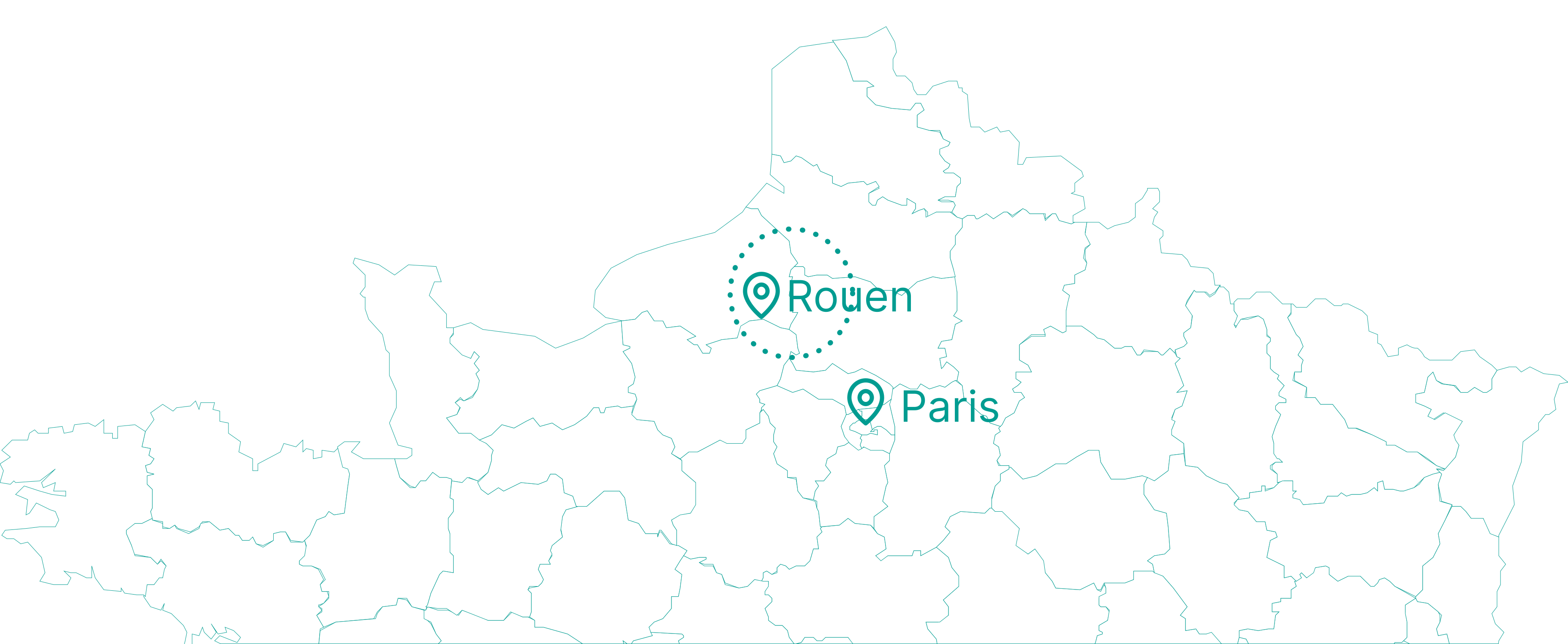
Have you ever visited Buchy? This charming village nestled between the Pays de Caux and the Norman Vexin, and serving as a gateway to the Pays de Bray, hides a remarkable historical treasure: its market halls!
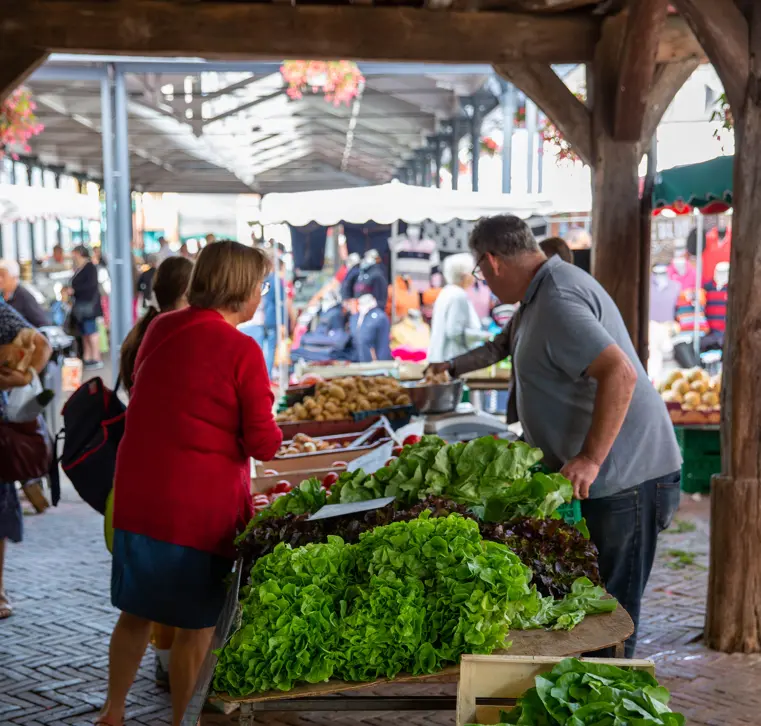
Every Monday since at least 1227, the weekly livestock market has brought life to the village. The market is therefore more than 800 years old and predates the market of Bolbec, which dates back to 1326.
Originally, the market took place around the Notre-Dame Church of Buchy, but with the construction in 1679 of the Butchers’ Hall and the Poultry Hall, it moved closer to the town hall. These halls, built from oak sourced from the Trianon grove, were the economic driving force of the lords of Bois-Héroult.
.jpeg)
These two halls, listed as Historic Monuments since 1934, are not the only ones in the village. Behind the Poultry Hall stands the Butter Hall. Built in 1878 by a Rouen architect named Lemoine, this hall is the only one of the three made entirely of metal.
There was once a fourth hall, nicknamed the Pig Hall, located near Notre-Dame Church. The Pig Hall was built in 1929 and dismantled in 1961 after being damaged during the bombings of 1940.
Why so many halls? Because the Buchy market was once so prosperous that at one point it alone accounted for nearly 80% of the municipality’s budget!
Even more intriguing: a bronze statue created by Jean-Marc de Pas stands at the entrance to the Butchers’ Hall. The statue, depicting Ernest Noury, pays tribute to the local naturalist and Knight of the Legion of Honour, who housed his museum there from 1958 until 1987, when his collection joined that of the Muséum d’Histoire Naturelle de Rouen.
Buchy is one of the many treasures that make up Normandie Caux Vexin. Just a few kilometers away, you can also discover the Jardin de Valérianes, the sculpture garden of the Domaine de Bois-Héroult, the Château d’Ernemont-sur-Buchy, and the Château de Blainville-Crevon with its collegiate church.